Buying a Flood-Zone Home at a Discount in Auckland: What the New Data Shows and What to Check First
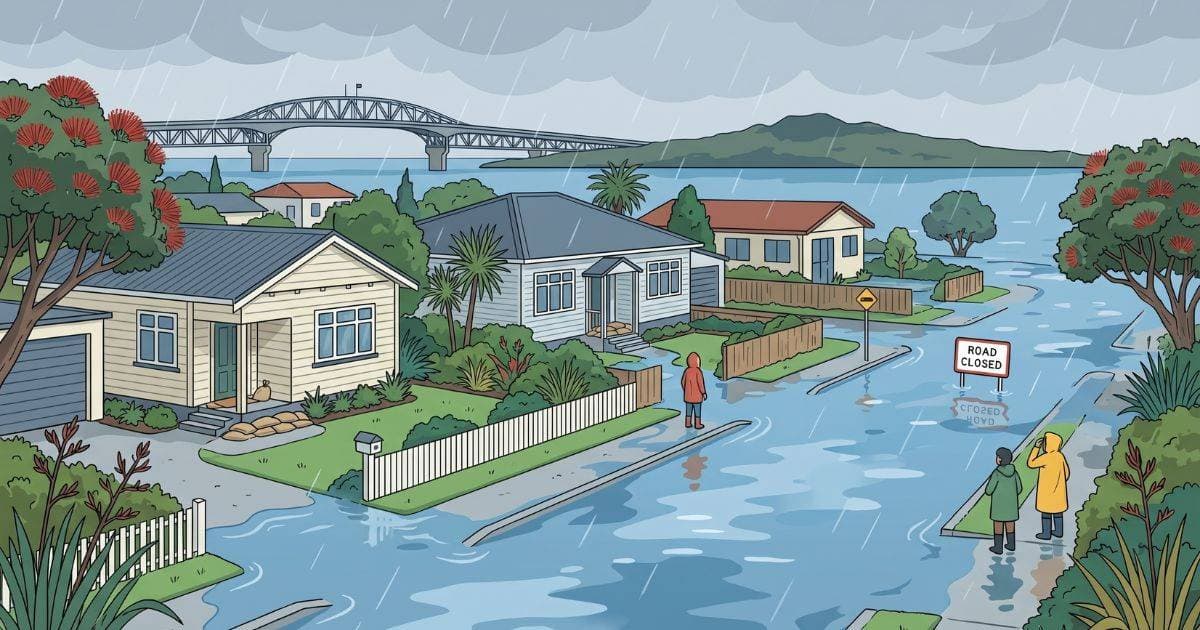
New Zealand buyers were supposed to walk away from flood-zone homes. New data suggests many are doing the opposite.
Analysis by property data firm Cotality, reported by RNZ in early July 2026, compared sale prices for flood-zoned houses against unaffected properties within 500 metres of them. In Auckland, flood-zoned houses sold at a discount of roughly $70,000 to $100,000. They also gained value faster, up around 18 per cent since 2020 against about 13 per cent for comparable properties with no mapped risk. The analysts were surprised enough to check the numbers more than once.
Those are market-level figures averaged across many sales. Any individual property can sit a long way either side of them, in price and in risk, which is exactly why the rest of this article exists.
Whatever you make of that as a market signal, it settles one question. Auckland buyers are not refusing flood-zone properties as a category. They are pricing them. And that moves the real question from whether anyone should ever buy in a flood zone to something more useful: if you are considering one of these properties, how do you make sure the discount you are getting reflects the actual risk profile of the specific address in front of you? That is a due diligence question, and it has an order of operations.
§ 1.0First, “flood zone” is not one thing
The phrase covers at least four different council layers in Auckland, and they mean genuinely different things. The floodplain and the flood prone area, in particular, are the two flood labels buyers most often confuse.
Floodplain
Where council hydraulic modelling predicts water would flow and pond in a 1 per cent AEP storm, the so-called 100-year event.
Flood prone area
A topographic depression where water may pond if drainage is blocked or overwhelmed. It is a formal notation that appears on the LIM.
Overland flow path
A surface corridor that carries runoff when the pipe network is at capacity.
Coastal inundation
Storm tide and wave water on low coastal land, modelled with sea level rise added.
Two properties can both be described as being in a flood zone in a listing conversation while carrying completely different combinations of these layers. A floodplain through the dwelling footprint and an overland flow path clipping the back corner of the section are not the same finding, and they should not be priced or investigated the same way.
Position and extent matter as much as presence. A layer that touches a corner of the parcel is a different situation from a layer that crosses the building platform. Ground level relative to the modelled water is different again, which is why an elevated house can sit inside a mapped extent that in practice affects the lawn. Some of these layers, coastal inundation especially, rest on climate-adjusted modelling that already builds in sea level rise. The regional models cannot tell you everything about your specific site, but where the mapping sits on the parcel is knowable before you offer, and it changes every conversation that follows.
This is the property-specific part.
A Know Your Risk report shows which of the seven hazard layers touch the address, how each is classified, and what each finding may mean under Auckland's current rules. Instant PDF, $49, before you spend anything bigger.
Check the address →§ 2.0The order of operations
The buyers and professionals in RNZ's reporting described an approach worth copying, and it runs in a particular sequence for a reason: cheap checks first, expensive commitments last. Step one leans on free council tools, including what the Flood Viewer shows for any address.
Map the hazards before you fall in love
Free tools first. Auckland Council's Flood Viewer and GeoMaps show the flood layers for any address in a few minutes and cost nothing. However you do it, this step happens before an offer, not during the panic of a due diligence clause.
Talk to an insurer before you spend on anything else
Mortgage advisers working with first-home buyers make this the first call once a flood layer shows up, before paying for a valuation, a builder’s report, or legal work. Lenders generally require insurance for a mortgage, so the insurance conversation sits upstream of the finance one. Contact two or three insurers with the specific address and ask about premium, flood excess, and any exclusions. Their answers can differ, which is exactly why you ask more than one.
Order the LIM and read the property file
The LIM carries the council’s formal hazard notations, and the property file can show flooding history, past consents, and any remediation. Being in a mapped area and having actually flooded are two different facts; confirming whether the property has suffered flood damage is a core check.
Ask the vendor direct questions
Has the property flooded, when, what was damaged, what was repaired, and is there documentation? Sellers of flood-mapped properties are increasingly prepared for these questions. Put them in writing through your lawyer if the answers matter to your decision.
Read the site, not just the map
Visit during and after rain. Look at whether the land falls toward or away from the house, the gully context, whether neighbouring homes show damp or mould, and ask neighbours how the street came through the 2023 Anniversary floods. None of this replaces the modelling; all of it adds information the modelling cannot see.
Bring in an engineer if the stakes justify it
If the layers cross the building platform, if you are planning works, or if the property is at the top of your budget, a site-specific flood assessment by a chartered professional engineer can establish what the regional model can only estimate. This is the expensive step, which is why it comes last, informed by everything above.
§ 3.0What the discount does and does not buy you
A price discount compensates you for accepting a risk. It does not remove the risk, and it does not change any of the following.
The mapping stays with the property. The hazard notations that informed your discount will appear on the LIM when you eventually sell, and the next buyer will run the same checks you did. The Cotality analysis itself noted that discounted entry prices and strong recent growth say nothing about how these properties perform over longer horizons.
The consenting context stays too. Auckland's natural hazard rules under Plan Change 120 have had legal effect since 3 November 2025. Chapter E36 classifies flood hazard areas into categories and assesses proposed development against a risk matrix that considers what the activity is and how sensitive it is. If you buy an existing dwelling and simply live in it, nothing about the rules changes your day to day, though the practical realities of living in a flood zone are worth planning for. If you later want to extend, renovate substantially, or rebuild, the application may need to address those rules, and in the higher categories that may shape what is realistic. This is the occupancy versus development distinction, and it is worth being honest with yourself about which buyer you are before the discount does your thinking for you.
Insurance terms are set year by year. A policy you can obtain today is a fact about today. Premiums and excesses are reviewed at renewal, and each insurer prices on its own assessment. The practical protection is not a prediction, it is the habit of getting the address-specific insurance answer in writing before you commit, and budgeting on the numbers you were quoted rather than on averages.
§ 4.0Questions worth writing down
Before an offer on a flood-mapped Auckland property, you want answers to these, in roughly this order. Which layers touch the parcel, and where do they sit relative to the dwelling? What does each classification actually mean for this address? Will an insurer cover it, at what premium and what flood excess? Has the property flooded before, and what do the LIM and property file show? What did the 2023 events do here, according to records and neighbours rather than the listing? If I ever want to do work on the house, what may the E36 rules ask of that application? And after all of that, does the discount on offer still look like compensation, or does it start to look like the reason the property is for sale?
None of these questions has a universal answer. All of them have an address-specific one.
Check any Auckland property against seven hazard layers
With PC120 context for every finding, before the offer rather than after. Free preview, instant $49 PDF report.
Search the Address →Sources
RNZ, Flood-risk homes defy analysts' expectations, gain value faster than unaffected properties, 3 July 2026 (Cotality data)
Auckland Council, Flood Viewer and GeoMaps (natural hazards)
Auckland Unitary Plan, Chapter E36 Natural Hazards and Flooding, as amended by PC120 (legal effect from 3 November 2025)
Auckland Council, PC 120: Housing Intensification and Resilience
This article summarises publicly reported data and public council information in general terms. It is not financial, legal, engineering, or insurance advice, and it does not make a recommendation to buy or not buy any property. Hazard classifications and planning rules can change. Verify the current position with council sources and licensed professionals before making property decisions.
Related Blog Posts